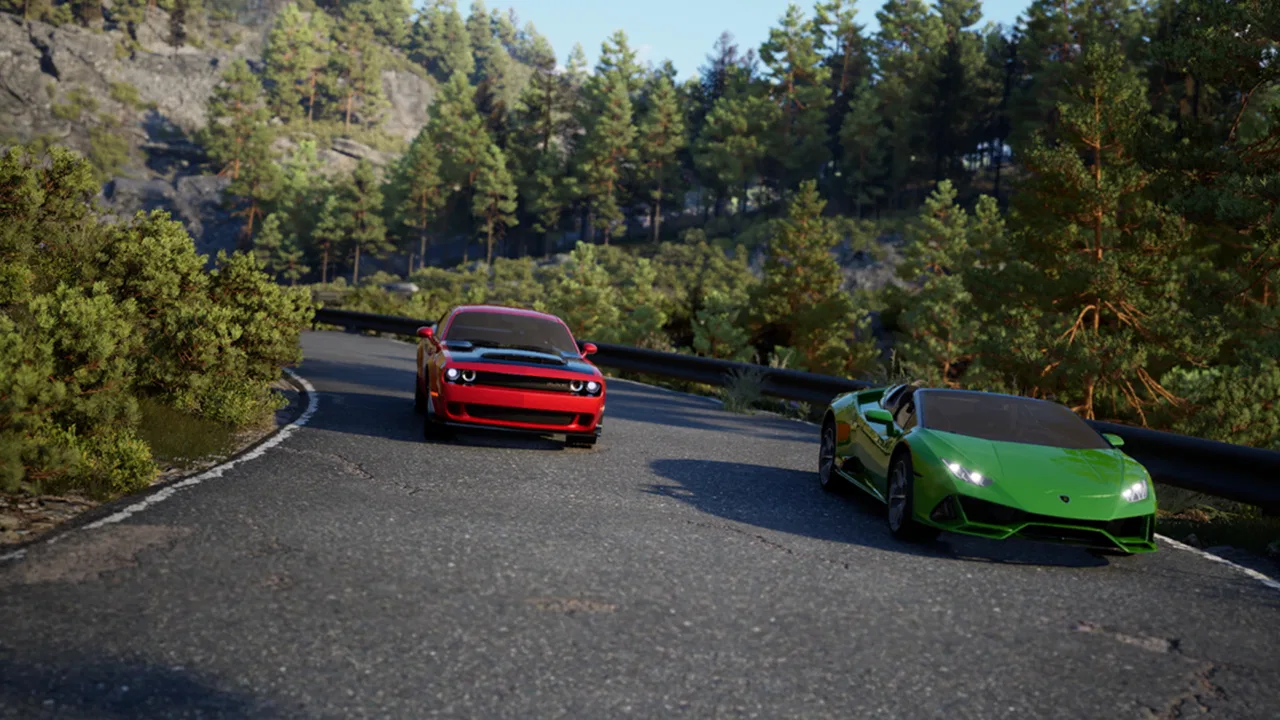
Top Drives - Car Race Battles
- 4.3
- Rating
- 10.00M
- Installs
- Free
- Price

 Analysis by App-foxy
Top Drives - Car Race Battles is the kind of racing game I recommend to people who enjoy making decisions as much as watching cars move. It is made by Hutch Games, but it does not play like a traditional driving simulator: you collect cars, improve them, and place them into races where preparation and matchup choices matter more than steering skill. I found that difference important from the first session, because the game looks like a fast racer while behaving more like a compact strategy game built around cars.
The basic idea is easy to understand. You build a garage, enter events, choose suitable cars for the available challenges, and spend resources on upgrades. The store summary describes it as a strategy motor game focused on racing, upgrading, and driving challenges, and that is a fair description without telling the whole story. The real appeal comes from learning why one apparently weaker car can be the better choice for a particular race, while a powerful machine can become a poor pick when the surface, distance, or course layout changes.
It is free to download and aimed at Everyone, which makes it approachable for younger players and casual racing fans. It has also built a large audience, with over ten million installs, an average rating of 4.3 from around 441 thousand ratings, and roughly 18 thousand written reviews. Those figures suggest a well-established game, but they do not remove the need to understand its style. If you want direct control, drifting, and the feeling of personally driving every corner, this is probably not the right racing game for you.
You May Also Like

 Blood Strike: 2.5 Anniversary
Blood Strike’s Loadouts Turn Every Drop Into a Tactical Gamble
A close look at Blood Strike’s custom loadouts: how fast access to signature weapons reshapes its battle royale rhythm, rewards preparation, and narrows the gap between fights.

 Pandora - Music & Podcasts
Pandora’s Music Is Easy to Start, but Harder to Recover
Pandora’s strength is its low-effort path from a seed to a station. Its weak spot is how much confidence it asks you to place in connection, setup, and quiet recovery.

 8 Ball Pool
 Is Built on Rivalries, Rematches, and Routine
A close look at the rivalries, rematches, shared routines, and unanswered safety questions that turn a quick pool match into a persistent mobile community.

 Samsung Music
’s Quiet Strength Is Playing What You Already Own
Its reach comes less from spectacle than from dependable access to a personal library. That simplicity is both the app’s strongest retention engine and its ceiling.

 AccuWeather: Weather Radar
AccuWeather Review: A Quick, Clear Forecast for Everyday Decisions
For everyday plans, the best forecast is the one you can understand quickly. AccuWeather makes rain timing, radar, and local conditions easy to act on, with a few trade-offs.

 Hill Climb Racing
Why Hill Climb Racing Still Turns Crashes Into One More Run
A tiny car, a bumpy hill and one more upgrade: Hill Climb Racing keeps resurfacing because its simple chaos makes every near-miss feel personal.
More From Our News Desk



How I approach a normal session
My usual workflow begins in the garage rather than on the track. I look at the cars I already own, check which ones are upgraded, and think about the kind of event I am preparing for. That small pause is worthwhile because blindly spending upgrade resources can leave a collection full of cars that are individually attractive but poorly suited to the next challenge. In Top Drives, a balanced garage is more useful than a single favorite vehicle.
When I enter a race, I treat the lineup screen as the main strategic moment. I compare the cars with the course requirements and consider whether acceleration, handling, grip, or top speed is likely to matter most. A short technical route rewards a different choice from a long, fast course. Wet or unusual surfaces can also change the decision. I do not simply place my highest-rated car into the first available slot; I try to match each car to the job it can perform best.
The races themselves are easy to follow because the game handles the driving while I make the important selections. That makes each event quick to understand, but it also means the result can feel decided before the animation finishes. I enjoy watching the outcome when my preparation was sound, especially when a careful matchup beats a more expensive-looking opponent. On the other hand, players who need moment-to-moment control may find the presentation passive.
A practical everyday scenario is a short break during a commute or lunch. I can open the game, inspect an event, make a few lineup decisions, and complete a small piece of progress without needing a long uninterrupted session. I would not call every part equally quick, because upgrading and comparing cars can become absorbing, but the race format suits brief visits better than a full simulator that expects constant attention.
The most useful habit I developed was separating “cars I like” from “cars I need.” A visually appealing or familiar car may be satisfying to keep, yet a less glamorous vehicle can fill an important role in a specific event. I also avoid treating a single victory as proof that a car is universally strong. Its value depends on where it is used, what it is upgraded for, and what other cars are available in the garage.
Settings and preparation that save time
Before settling into regular play, I check the device settings and the game’s available options rather than assuming the default setup is ideal. The important point is not to search for a hidden performance mode or imaginary shortcut; experienced play here comes from using the controls and presentation in a way that keeps the garage and race information easy to read. I prefer a clear setup that lets me inspect cars and event details without rushing.
I also make sure the phone is comfortable for repeated short sessions. Racing games with animated results can encourage one-more-event play, and a cluttered notification environment makes it easier to miss what I was actually trying to accomplish. My practical approach is to open the game when I have enough attention to compare cars, then stop after a defined goal such as preparing one event or improving one useful vehicle.
There is another setting-related consideration: in-app purchases range from $0.99 to $249.99 per item. The game is free, but that does not mean every route through progression feels equally free of pressure. I recommend deciding in advance whether you are playing without spending, allowing only occasional small purchases, or treating the shop as part of your budget. That decision prevents a moment of frustration from turning into an impulsive purchase.
I would especially advise parents to look at the purchase environment before handing the game to a child. The Everyone age rating describes the content audience, not a promise that every spending decision will be simple. The game can be suitable as a family-friendly racing strategy title, but the financial side still deserves adult supervision.
The current version is 30.00.00.22131, and the minimum operating system listed is Android 7.0. That makes it accessible to many older Android devices, although compatibility on paper is not the same as a smooth experience on every phone. If your device is modest, I would pay attention to heat, battery use, and loading behavior during a longer session rather than assuming that the minimum system requirement guarantees perfect performance.
Repeatable patterns that make progress smoother
The fastest improvement does not come from tapping through races as quickly as possible. It comes from repeating a sensible review pattern: inspect the event, identify the course demands, select cars for specific roles, and upgrade with a purpose. I use the same sequence every time because it reduces careless decisions. It also makes losses more informative; instead of simply blaming bad luck, I can ask whether the wrong car was assigned to the wrong kind of race.
One useful pattern is to keep a mental record of what each car does well. I do not need a separate spreadsheet for ordinary play, but I remember whether a vehicle has been reliable on technical routes, stronger on faster sections, or useful when the surface changes. This turns the garage into a set of tools rather than a collection of icons. The benefit becomes clearer as the number of cars grows and a quick visual comparison is no longer enough.
I also avoid upgrading randomly just because a button is available. An upgrade should answer a question: will this car become more useful in the event I am preparing for, or will it improve a role that my garage currently lacks? That mindset protects resources and keeps the collection flexible. It is one of the less obvious lessons of the game, because new players can easily assume that every improvement is automatically valuable.
Another efficient habit is to review the result after a close race. If a car lost narrowly, I consider whether a targeted improvement could change the matchup. If it lost badly on a course that did not suit it, I do not immediately spend resources trying to force it into a role it was never meant to fill. That distinction saves time and helps prevent a common mistake: upgrading a poor matchup instead of choosing a better car next time.
The game is also easier to enjoy when I accept that not every event deserves the same level of attention. For a straightforward challenge, I make a quick lineup and move on. For a difficult or unfamiliar combination of courses, I slow down and compare the available options. This flexible pace keeps the strategy interesting without turning every race into a lengthy calculation.
Where the strategy becomes more demanding
Top Drives becomes more compelling when the obvious choice stops working. A high-performance car is not automatically the best answer, and the most expensive-looking vehicle in a collection cannot solve every course. The advanced part is understanding trade-offs: a car may be quick but awkward on a technical route, strong on one surface but less convincing on another, or useful only when paired with the right selection of teammates.
I find the game most rewarding when I build a lineup with complementary jobs rather than five versions of the same idea. That approach gives me more ways to respond when an event includes varied courses. It also makes collection growth feel meaningful, because a new vehicle can matter even if it is not the strongest car I own. Its value may come from covering a gap that was previously forcing me into weak matchups.
There is a limit to how much control the player has. You can make careful choices, but you do not drive the car through each turn, correct a mistake, or create a dramatic comeback with a last-second maneuver. The result is therefore partly about preparation and partly about accepting the game’s automated race presentation. I think that is a deliberate trade-off, but it is still a genuine limitation for anyone coming from games built around manual steering.
Progress can also feel demanding when the cars you want are not immediately available or when your garage lacks the right combination for an event. The free-to-play structure means patience matters, and the shop can make the process feel more tempting when you are stuck. I would not recommend spending simply to overcome a single frustrating challenge. If the strategic collection loop is not enjoyable at a slower pace, purchases are unlikely to fix the underlying issue.
For that reason, I see this as a better alternative to arcade racers for players who enjoy planning, but not necessarily a replacement for them. A game with direct steering is better if your priority is reflexes, drifting, or learning a track through repeated driving. A traditional racing manager may suit someone who wants deeper long-term team administration. Top Drives sits between those options: it keeps races accessible while making the garage and matchup decisions the main attraction.
Who will enjoy it, and who should pass
I would recommend it to someone who likes car collecting but wants more to do than admire a garage. It works particularly well for players who enjoy comparing strengths, preparing for different conditions, and making a decision before seeing the result. It is also a good fit for short sessions, provided you are comfortable with a game that can invite longer planning whenever a new event or upgrade choice catches your attention.
I would be more cautious about recommending it to a player who wants licensed-feeling driving action, continuous manual control, or a purely skill-based race. The automated format can feel detached if your idea of racing is braking at the right moment and taking a corner cleanly. I would also skip it if you dislike free-to-play economies on principle, because the presence of purchases from small amounts up to $249.99 per item is an important part of the decision.
New players should not worry about understanding every car immediately. Start by learning the relationship between course type and car role, then improve the vehicles that repeatedly help you. Experienced players can get more depth from reviewing lineups before committing resources and from resisting the urge to upgrade every new addition. In both cases, the best progress comes from building a garage that gives you options rather than chasing one perfect car.
The developer, Hutch Games, has clearly focused the experience on making car knowledge and preparation feel active without requiring driving controls. That design is why the game can be played casually while still leaving room for careful optimization. It is not a racing game that hides a simulator underneath; it is a strategy game using racing as its language.
My verdict after settling into the garage
After spending time with it, I see Top Drives - Car Race Battles as a focused choice for strategy-minded racing fans. Its strongest feature is the way ordinary car comparisons become meaningful once the course and surface change. I enjoy the small satisfaction of placing the right car in the right race, especially when the result rewards preparation rather than simply choosing the vehicle with the biggest reputation.
Its weaknesses are just as clear. The driving is not interactive, progression can test your patience, and the purchase range means I would approach the free download with sensible spending boundaries. The game also asks you to enjoy repeated comparison and collection management; if that sounds like work instead of fun, the races will not provide enough direct action to compensate.
My advice is to try it as a strategy racer, not as a conventional driving game. Give yourself time to learn your garage, use upgrades to solve specific problems, and treat each event as a matchup puzzle. With that expectation, the free entry point is worthwhile, and the large player base makes sense. The best reason to play is not watching cars race; it is learning why your choice won.
FAQs for Top Drives - Car Race Battles
01What is Top Drives - Car Race Battles all about?
Top Drives - Car Race Battles is a strategic racing game where players collect, upgrade, and race a variety of cars. The game combines elements of card collecting and tactical racing, allowing players to build a deck of cars and compete in various events and challenges. The focus is on strategy and vehicle performance rather than real-time driving.
02How does the car collection system work in Top Drives?
In Top Drives, players collect cars by earning card packs through gameplay or purchasing them in the in-game store. Each card represents a different car with specific stats and performance attributes. Players can upgrade and tune their cars to improve their performance in various race conditions, strategically selecting cars for each challenge.
03Is Top Drives free to play, and are there in-app purchases?
Top Drives is free to download and play on both Android and iOS devices. However, the game offers in-app purchases for players who wish to acquire additional card packs, currencies, or other premium features more quickly. While purchases can enhance the experience, they are not necessary to enjoy the core gameplay.
04Do I need an internet connection to play Top Drives?
Yes, an internet connection is required to play Top Drives. The game features online multiplayer modes and regular updates, necessitating an active internet connection to access all content and features. Players should ensure they have a stable connection to avoid disruptions during gameplay, especially in competitive modes.
05What are the main strategies for success in Top Drives?
Success in Top Drives relies on a combination of strategic car selection, upgrading, and tuning. Players should focus on building a versatile deck of cars that can handle various race conditions. Understanding each car's strengths and weaknesses, and deploying them effectively in events, is key to advancing through the game and defeating opponents.
Pros
- Extensive car collection available.
- Realistic car performance stats.
- Engaging strategic gameplay.
- Regular updates with new cars.
- Challenging events and rewards.
Cons
- In-app purchases can be expensive.
- Requires a stable internet connection.
- Some cars are hard to unlock.
- Limited offline play options.
- Graphics can be demanding on devices.

Top Drives - Car Race Battles
Gallery